
Your Dose of Reg.exe, Week {22}
Mistral 3 and DeepSeek V3.2 lead major model releases. Gradium launch. Biotech faces reality: pharma wants approved drugs, not benchmarks. Infrastructure scales to GW. OpenAI acquires Neptune.ai.

Reg.exe is a global closed community of 260+ engineers, founders, and researchers interested in AI innovation, from San Francisco to Tokyo. Each week, we share the highlights of our discussions in a newsletter. If you’d like to join, write to join@welovesota.com
👉 Article originally posted on WeLoveSota.com
Events
🎙️ Voice AI Space - December 10 - Paris - Full day packed with inspiring talks, expert panels, hands-on workshops, and networking opportunities with the Voice AI community at CNIT Paris La Défense.
Audio
🎙️ Gradium.ai Announced Seed Round - Kyutai’s first spin-off secured €60 million in seed funding. The company provides state-of-the-art text-to-speech and speech-to-text models via API. (🙏 Laurent Mazare, Pierre Chapuis)
Autonomous Agents
📊 tau2-bench as Agent Benchmark Standard - Discussion emerged about tau2-bench becoming the standard way to demonstrate foundational model capabilities for agents. Anthropic used the benchmark to showcase Claude Opus 4.5’s agent performance. The benchmark appears to be increasingly important for validating model effectiveness in agent-based tasks. (🙏 Robert Hommes)
🎛️ MCP Functionality Debate - Reddit thread about Model Context Protocol (MCP) functionality was shared, with Garry Tan stating “MCP barely works today.” With people commenting the MCP protocol itself is fine and already useful in real setups, so “barely works” is seen as an exaggeration. The real issues are rough DX, security/auth friction, and inconsistent quality of MCP servers and tooling, which make production use feel fragile today. (🙏 Mario Cornejo)
Biotech Health And Chemistry
📊 MLIPAudit Benchmarking Suite - MLIPAudit introduces a physics-based benchmarking suite designed to stress-test the mlip library’s models on downstream tasks such as protein folding and liquid dynamics.
🔥 Community take w/ Sophie Monnier: One key finding is that standard training metrics like RMSE and MAE for energy and force can fail to predict simulation stability, although the library’s SPICE2-trained models generalize remarkably well to biomolecular systems compared with those trained solely on gas-phase data.
🏥 Selling AI to pharma reality check - Axiom’s CEO published insights on selling AI products to pharmaceutical companies. The key finding: pharma wants approved drugs, not incremental benchmark improvements. Success requires demonstrating lower toxicity, better efficacy, and evidence progression from cell data to mouse data, ideally reaching human data validation. Beating AlphaFold by 2% on obscure benchmarks carries no weight in pharma sales.
🔥 Community take w/ Felix Raimundo: TL;DR: They want approved drugs and everything else is noise. No one cares that you beat AlphaFold by 2 percent on an obscure benchmark. What matters is lower toxicity, better efficacy, and credible evidence. That means starting with cell data, then moving to mouse data, and ideally human data, though no one can currently deliver that last piece.
🧬 Generate:Bio Phase 3 claims - Generate:Biomedicines claimed to be the first company with an AI-designed drug in Phase 3 trials for GB-0895, an anti-TSLP antibody for severe asthma.
🔥 Community take w/ Felix Raimundo: Amusingly, that implies Insilico never actually hit that milestone. But when you look closely:
They skipped phase 2 entirely. Maybe you can get away with that for mAbs because the development and safety profiles are so standardized, but it’s still puzzling.
The antibody itself is a me-too drug. Tezepelumab hits the same target and was approved in 2021, well before they even began phase 1.
It’s their flagship program, which mostly reads as a case study in how to burn a billion dollars.
🙏 RFDiffusion3 fully open sourced - The complete RFDiffusion3 codebase and models became available on GitHub through the RosettaCommons foundry repository. This release provides the community with access to advanced protein structure prediction and design capabilities. (🙏 Sophie Monnier)
Image, Video, 3D
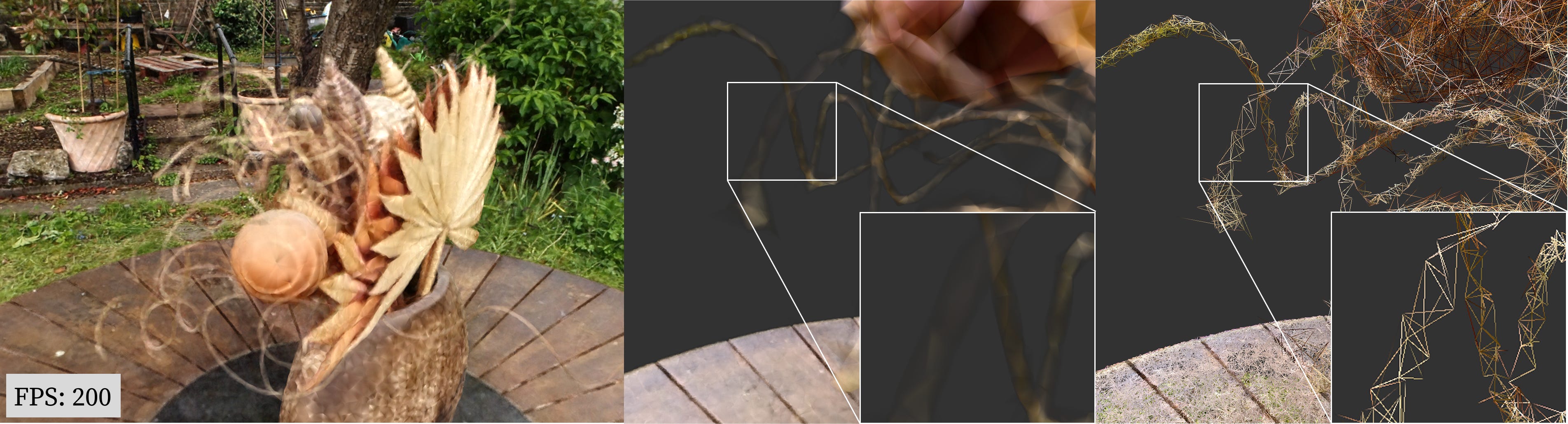
☀️ Radiance Meshes for Volumetric Reconstruction - Google released major paper from original Gaussian Splatting and NeRF authors introducing radiance meshes. These volumetric triangle meshes use Delaunay triangulation with constant density and linear color per tetrahedron. The trained meshes can be directly integrated into game engines or physics simulations, render at 200+ FPS at 1440p on RTX4090 using hardware rasterization, and support conventional mesh editing tools. The approach delivers super high quality, watertight meshes. (🙏 Samuel McFadden)
🎞️ Runway Gen-4.5 Released - Runway launched Gen-4.5 as the world’s top-rated video model, offering unprecedented motion quality, prompt adherence, and visual fidelity. The model represents a new frontier for video generation with state-of-the-art capabilities across all metrics.

👓 OpenQuestCapture Released - OpenQuestCapture is an open source Meta Quest 3 spatial capture app for 3D reconstruction and Gaussian splatting by Samuel McFadden. The application captures Quest 3 depth/RGB/pose data with live point cloud visualization and converts to COLMAP format. The hardware is 10x cheaper than professional-grade spatial capture sensors, making spatial capture more accessible. The pipeline can be uploaded to vid2scene.com for cloud processing.
🔥 Community take w/ Samuel McFadden: I’ve been working on this for a while and I’m finally ready to share it. Meta’s Hyperscape Capture is impressive, but you don’t own your data. Quest hardware is surprisingly capable and about ten times cheaper than professional spatial-capture systems, so I wanted to unlock that with an open pipeline.
🎥 Kling Launched O1 Model - Kling VIDEO O1 has been announced as a unified multimodal video model that accepts any mix of text, images, elements, or video to generate and edit 3–10s, reference-consistent, highly controllable clips in a single interface. (🙏 Hugo Hernandez, Gabriel Olympie, Pierre Chapuis)
🔥 Community take: Discussion emerged about increasingly confusing model naming conventions across the industry, with multiple companies using similar designation schemes.
🎥 SeeDream 4.5 from ByteDance - SeeDream 4.5 has been announced as ByteDance’s upgraded image generation and editing model, improving prompt adherence, multi-image consistency, and high-fidelity visual design for tasks such as reference-preserving edits, posters, and logo layouts.
Infrastructure
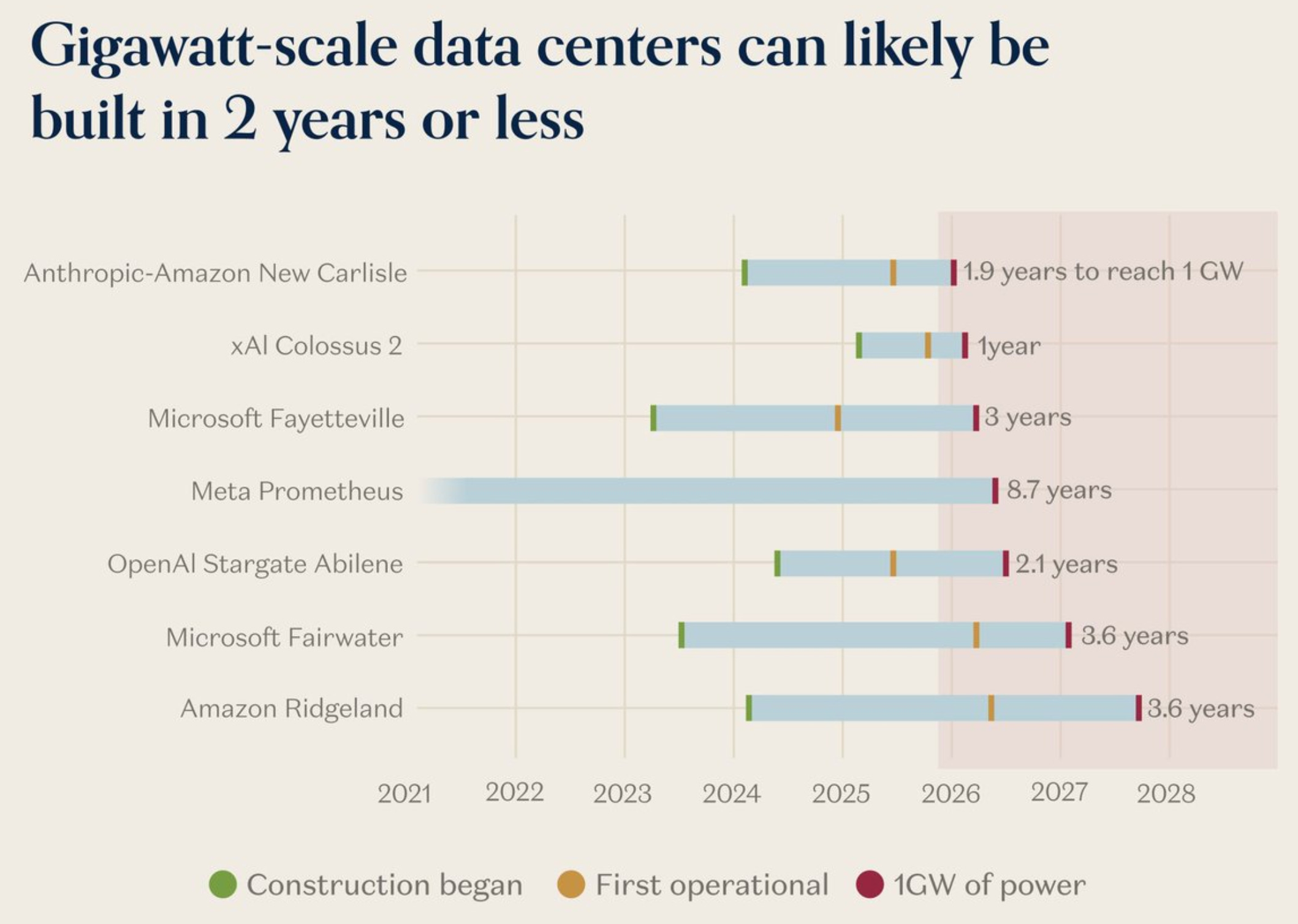
📈 Data Center Scale and AI Infrastructure Charts - The post argues that recent data contradict some popular tech narratives: AI coding tools’ traffic is rebounding after a perceived collapse, AI exposure does not neatly explain unemployment patterns, and high Series A valuations only weakly predict future startup returns. It also shows that hyperscale AI data centers are rapidly scaling to gigawatt levels, implying massive future energy demand and demonstrating that large physical infrastructure can still be built quickly.
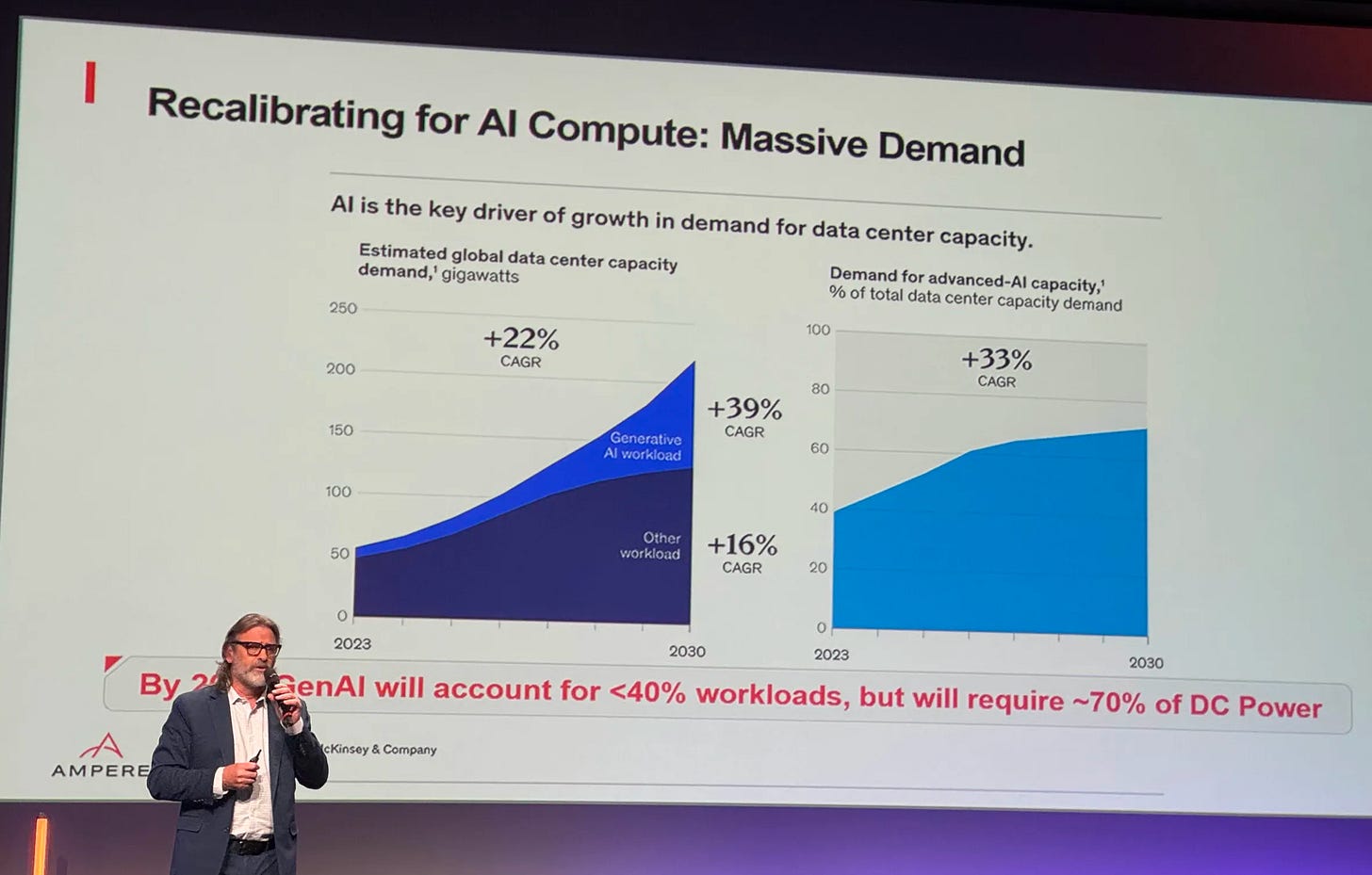
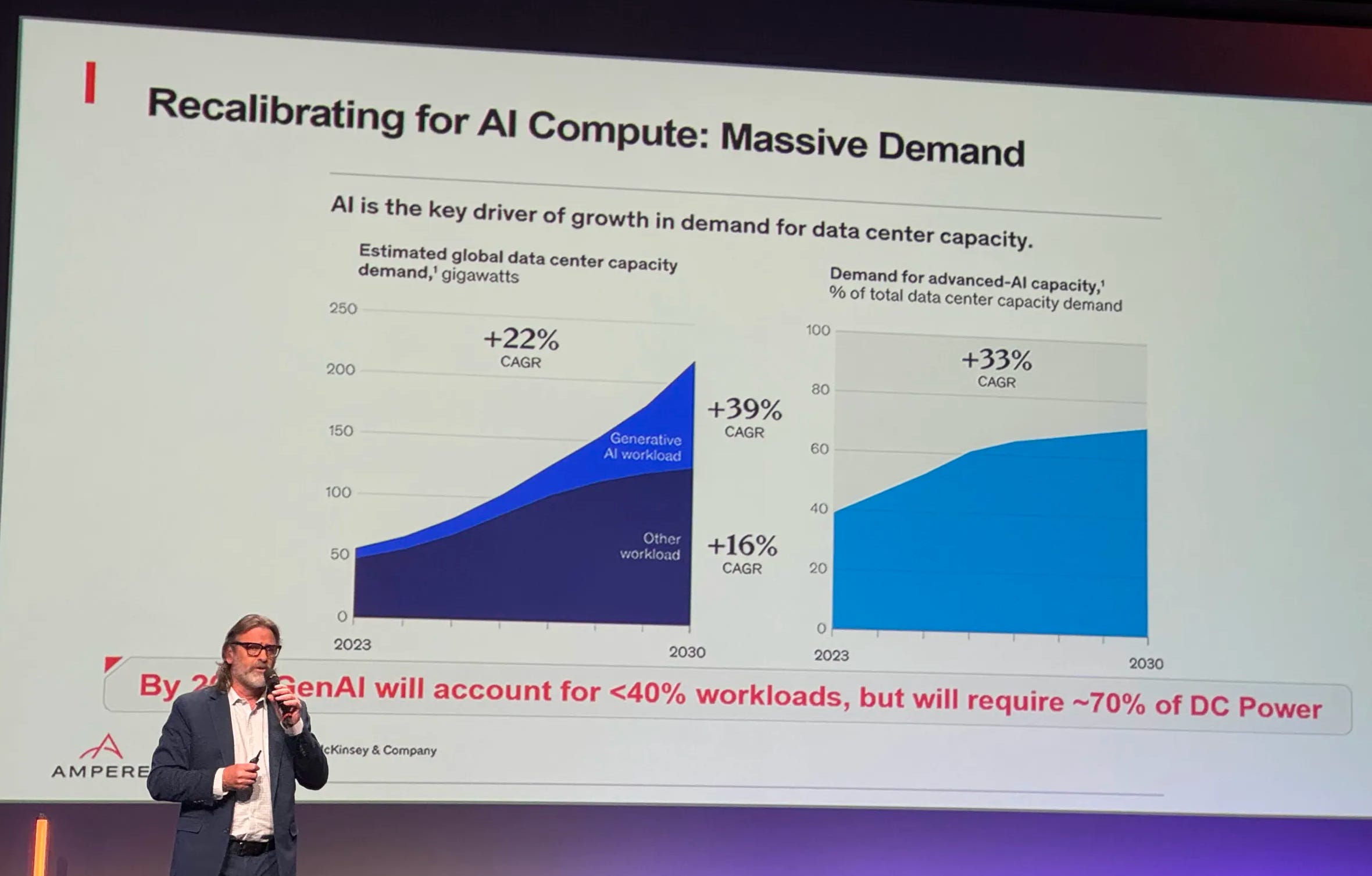
⚡️ Ampere AI Pulse Presentation - Sophie Monnier shared a picture from the AI Pulse event. The graph shows that although generative AI will represent less than 40 percent of data-center workloads by 2030, its rapid growth means it will drive most of the power demand, reaching roughly 70 percent of total data-center consumption.
Language
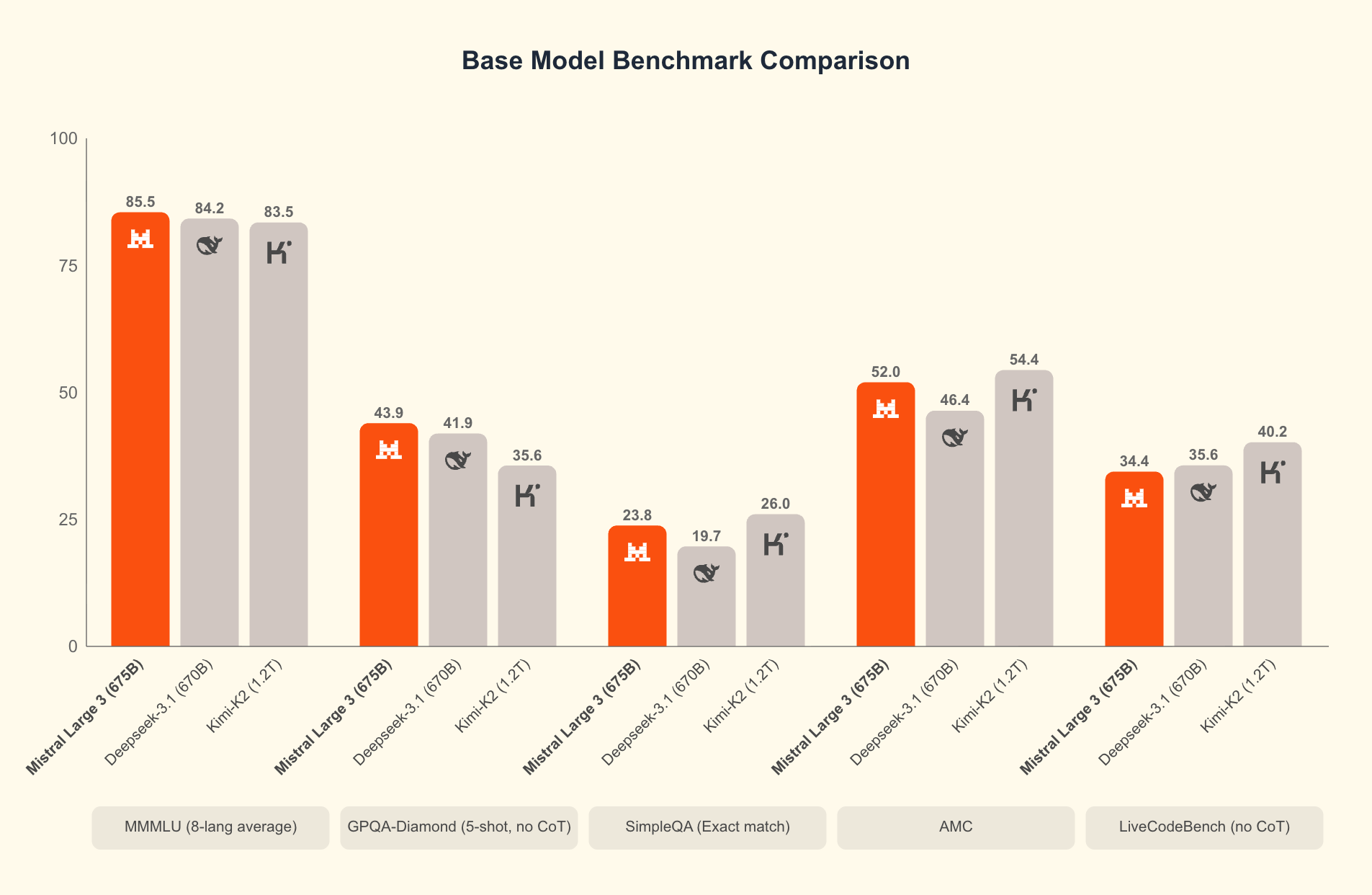
🔥 Mistral 3 Family Released - Mistral AI announced the next generation with Mistral 3 including three state-of-the-art small dense models (14B, 8B, 3B) and Mistral Large 3, their most capable model to date. Mistral Large 3 uses sparse mixture-of-experts architecture with 41B active and 675B total parameters. All models released under Apache 2.0 license in various compressed formats to empower developers and enable distributed intelligence. (🙏 Kemal Toprak Uçar)
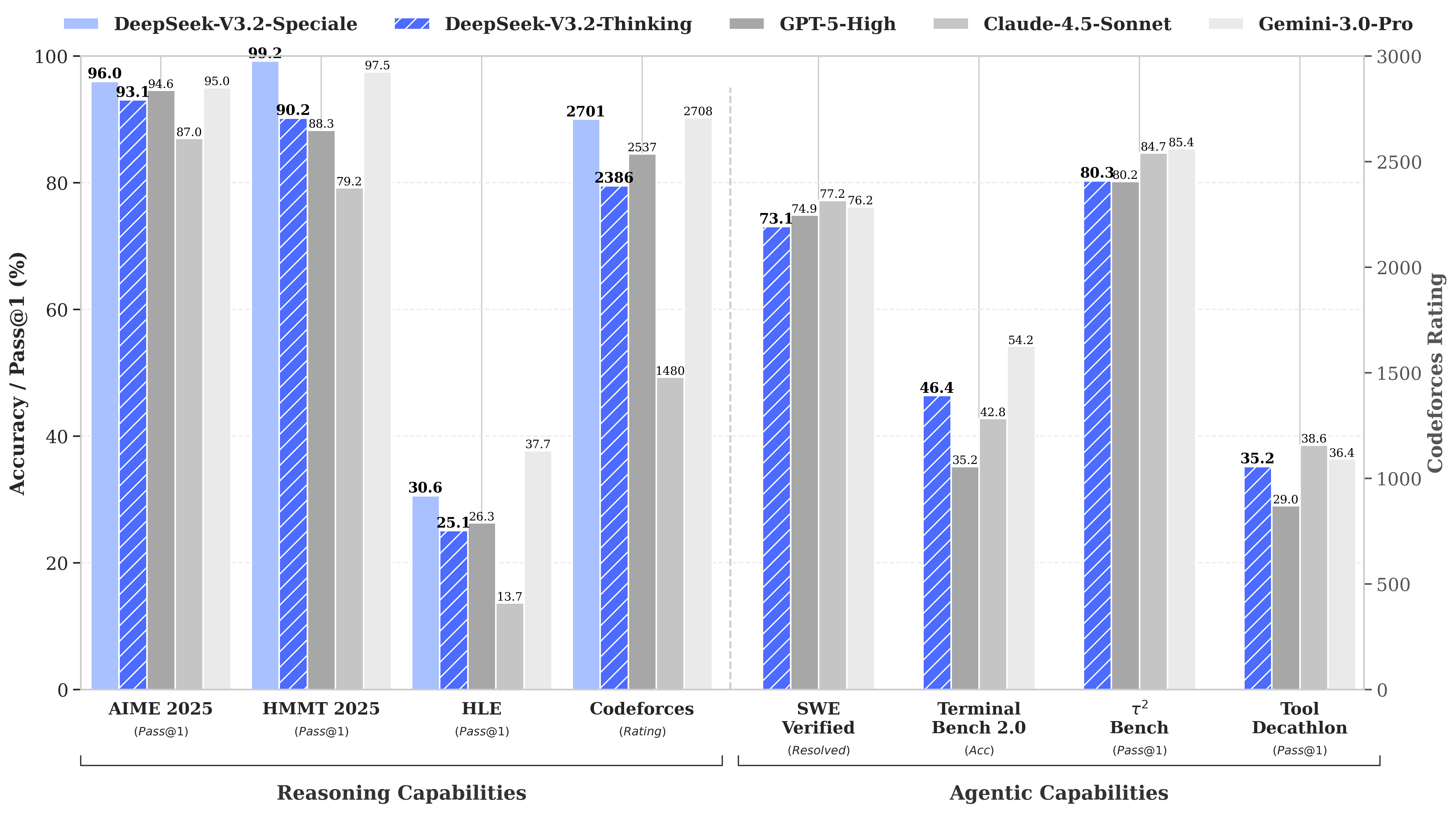
🔥 DeepSeek V3.2 “Speciale” Released - DeepSeek dropped V3.2 Speciale, rivaling Gemini 3 Pro in performance. However, the model consumed significantly more tokens, averaging 77,000 tokens to solve Codeforces problems compared to Gemini’s 22,000 tokens. The release represents a major advancement but highlights efficiency trade-offs in reasoning-focused models. (🙏 Hugo Hernandez, Kevin Kuipers)
📊 Openrouter’s charts - The report analyzes over 100 trillion tokens of anonymized real-world LLM usage on OpenRouter over roughly the past two years, showing rapid growth of open-source models (especially Chinese OSS), a shift toward medium and large models, and the dominance of roleplay and programming as key use cases, with programming now exceeding half of all token volume. (🙏 Kevin Kuipers, Julien Mangeard)
🔥 Community take: The findings are interesting, but the distribution is inevitably shaped by OpenRouter’s own user base.
Also:
🧠 Essential AI Announced Rnj-1 - The release emphasizes the importance of open-source AI development for long-term advancement and equitable diffusion of AI technologies. Founded by Ashish Vaswani, the company focuses on making frontier AI more accessible through open-source models and tools. (🙏 Fabien Niel)
🧄 OpenAI’s “Garlic” model codename - Internal leaks revealed OpenAI’s new model carries the codename “Garlic,” continuing their food-themed naming tradition for internal development builds.
MLOps
🤝 Neptune.ai Acquired by OpenAI - Neptune.ai entered definitive agreement to be acquired by OpenAI, subject to closing conditions. The hosted SaaS service will wind down after a 3-month transition period ending March 4, 2026. Self-hosted customers received direct contact from account managers for smooth transition planning. The acquisition raises questions about alternative MLOps platforms for displaced users.
Programming
🧑💻 Community take w/ Pierre Chapuis (Finegrain): Switched back from Codex to Claude Code with Opus 4.5 at work and the difference is stark. I don’t see how anyone would choose non-Anthropic models when they have the option, with the caveat that I haven’t tried Gemini 3 for this yet. Compared with Codex, the speed stands out first, but it also produces better code, understands intent more reliably, and responds more effectively to guidance. The one weakness is handling .pbxproj files for iOS work; it struggles there, so it’s safer to update those manually, though it won’t touch them unless you explicitly ask.
Robotic World Ai
🤖 UMA Bot Went Public - UMA (Universal Mechanical Assistant) officially launched their public website. The company develops AI and robotics to shape a new economic and societal era, designing general-purpose mobile and humanoid robots with human-level dexterity and deep understanding of the physical world. The team is accelerating development and growing multidisciplinary capabilities. (🙏 Pierre Chapuis)
Other Topics
😓 US Gen Z Sentiment on GenAI - Airbuds user data revealed 70% of users (predominantly 15-20 year olds from US) are “very against” or “against” GenAI, with only 30% neutral or favorable. Key concerns include job and housing threats, AI slop fatigue from GenAI flooding feeds, uncanny valley effects in visuals, and perception of GenAI music as DSP scamming or artist labor replacement. The indie culture emphasizes authenticity, potentially biasing the sample compared to general public. (🙏 Gawen Arab @ Airbuds, Niko Hosta)
🧠 Neuralink Overview Fall 2025 - Neuralink released overview presentation covering company history, Telepathy product and future roadmap, and engineering challenges. (🙏 Fabien Niel)
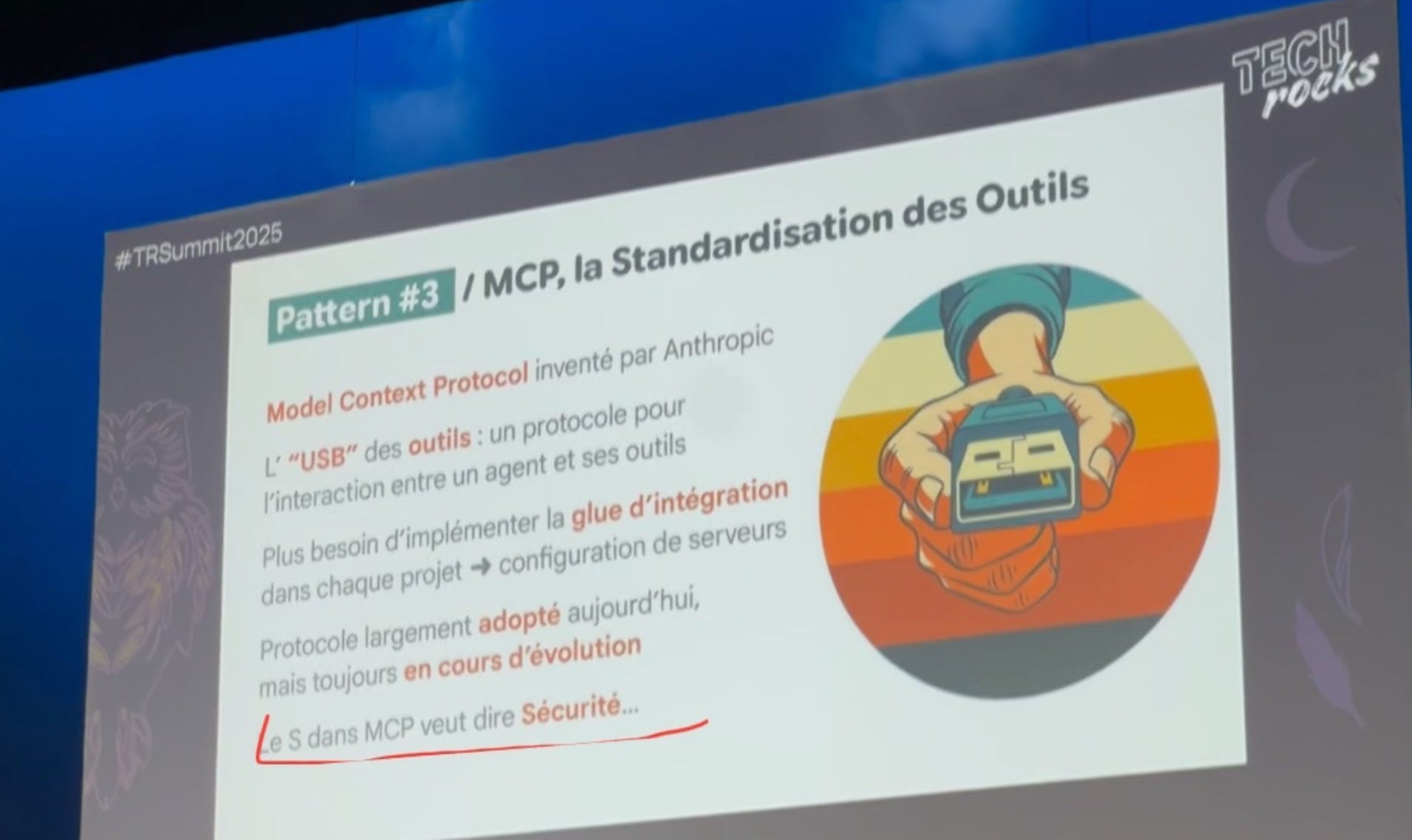
😈 MCP Security Joke - Guillaume Laforge from Google trolled at Tech Rocks Summit with image stating “The S in MCP means security” highlighting ongoing discussions about Model Context Protocol security considerations. (🙏 Guillaume Lesur)
Ask For Help
🇫🇷 Voice Accent Conversion Request - Vianney Lecroart is seeking for tools to convert video audio with French-accented English to native English accent while maintaining lip sync. Krisp AI was mentioned as a real-time solution, though it lacks features for pre-recorded video processing. (reach out to Vianney)
🤨 DoIT to Ingram Micro Transition - Maxence Maireaux received email about Root Account changes switching from DoIT to Ingram Micro without clear explanation, seeking information from others about the transition. (reach out to Maxence)
🙋♂️ AI Adoption Framework Request - Request for frameworks covering AI adoption in medium-sized Product & Engineering organizations, ideally addressing onboarding, adoption, ROI, security, and engineering KPIs like code quality and review coverage. Mentioned search for AI version of DORA metrics. (reach out to Lior Oren)
New Members
🇫🇮 Kasra Aliyon (Kopilo) - Co-founder at Kopilo, an AI-native workspace for scientific researchers described as “Cursor for Research.” AI researcher for 6 years building his third startup in the AI/ML space, currently hands-on developing AI agents. Hosts podcast “The AI Era” exploring the intersection of Humanity and AI. 📍Based in Helsinki, Finland.
🇫🇷 Maziyar Panahi (OpenMed) - Data and AI infrastructure lead at CNRS. Built platforms holding 360B+ web records and operates a 120+ node Hadoop cluster for large-scale ML. Contributes to open-source medical AI and post-training/RL. Former heavy-metal guitarist. 📍Based in Paris, France.
🇫🇷 David Martins Gonçalves (Notify AI) - CTO and co-founder of Notify AI, with 20+ years as an entrepreneur focused on scalable AI decisioning for CRM. Founded companies across Europe and South America. Passionate about solving real business problems. Enjoys boxing and reading. 📍Based in Paris, France.
🇫🇷 Sébastien Blanc (Java Champion) - Java Champion and Staff Developer Advocate blending Java, platform engineering, and AI governance. Known for helping teams modernize legacy systems. Frequent conference speaker, padel player, Half-Life fan, and owner of 5 cats. 📍Based in Vallauris, France
Excellent summary! Gradium sounds like a dream for audiobooks.